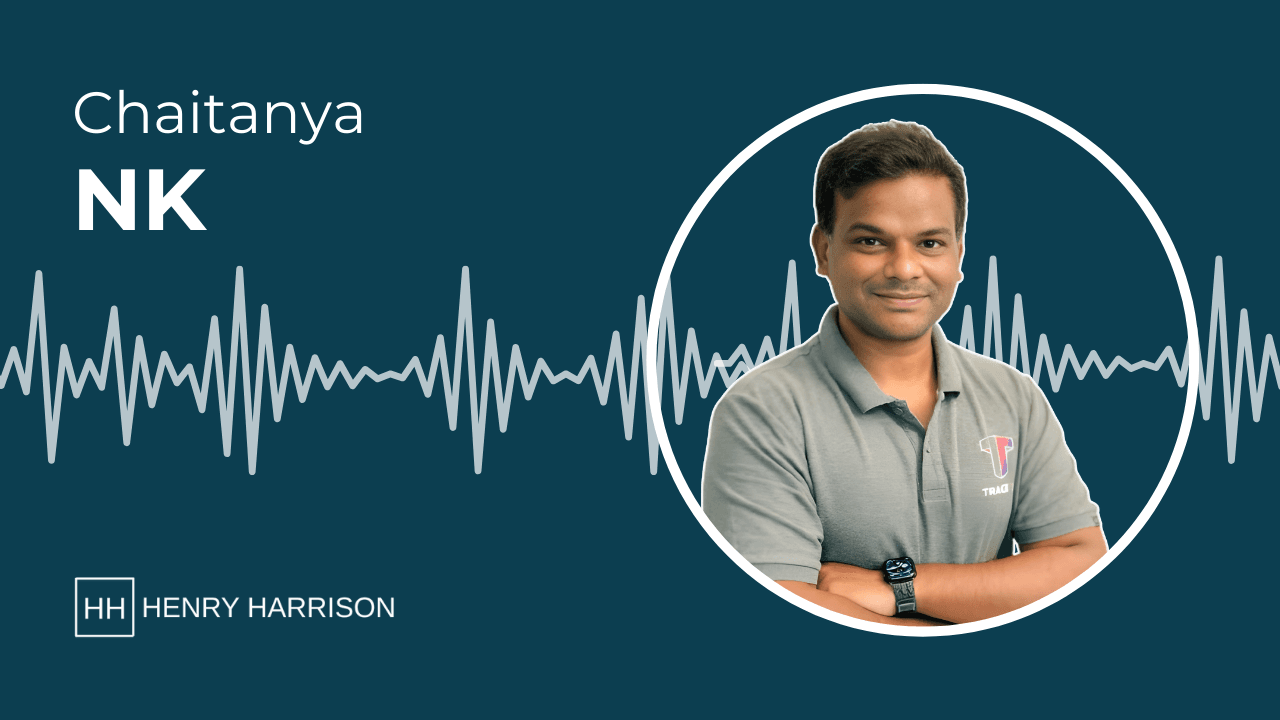
Chaitanya NK
Track 3D CEO Chaitanya NK on AI Construction Monitoring and Scaling a Construction Tech Company
How reality capture plus AI turns job-site progress into actionable data—without slowing down the field.
Chaitanya NK explains how Track 3D uses reality capture and AI to automate construction monitoring—showing what’s installed, what’s missing, and what’s off-spec without manual reporting. Henry and NK unpack the founder journey behind the product, the shift from founder-led sales to scaling go-to-market, and why adoption on the job site is the real test.
Watch / Listen
About This Episode
Construction projects routinely slip on schedule and budget, often because field data is collected manually and arrives late, incomplete, or inconsistent. In this episode, Chaitanya NK—Co-Founder and CEO of Track 3D—breaks down how his team is using reality intelligence (site capture + AI) to give project teams real-time visibility into progress and deviations.
Track 3D enables a superintendent or project engineer to walk a site with a camera (or use drones and robotics) while the system reconstructs the space in 3D, maps imagery to the floor plan, and automatically quantifies what’s been installed. The platform can flag issues early—like an HVAC duct installed in the wrong location or sprinkler heads missed before ceilings are closed—helping teams reduce rework and manage risk proactively.
NK shares how his background across 3D vision, AI, robotics, and digital twins led to Track 3D, and why this company is the first time he and his co-founders raised venture funding. With more than 400 job sites live—from airports and data centers to hospitals and single-family homes—the company is scaling go-to-market in the U.S. after raising a total of roughly $14.3M.
The conversation also highlights a key founder lesson: adoption is won in the field. If the tool isn’t simple and immediately useful, it won’t scale—no matter how strong the top-down mandate is.
Key Insights
Manual job-site reporting creates delayed, inconsistent data—AI can turn reality into usable metrics.
Early detection of deviations (wrong placement, missing installs) is where rework savings compound.
Reality capture plus AI can quantify progress and map it to floor plans without manual input.
Field-first design matters: if crews don’t feel immediate value, adoption stalls.
“Zero learning curve” is a competitive advantage in construction tech.
Founder-led sales works early, but scaling requires dedicated go-to-market teams.
Hardware improvements (cameras, drones, robotics) amplify what AI can deliver.
Conferences and job-site visits still matter because trust and workflow fit are proven in person.
Episode Transcript
This transcript has been edited for clarity and readability. Filler words and minor repetitions were removed, and formatting was adjusted to improve flow. The substance and intent of the conversation remain unchanged.
Henry Harrison:
It’s going to be a terrific episode of the Henry Harrison Podcast—Entrepreneurs, Business, and Finance.
We’re fortunate to have NK, Co-Founder and CEO of Track 3D. He’s founded multiple companies over the years and has been building Track 3D for almost four years.
Hello, NK.
Chaitanya NK:
Hey, Henry. Thanks for having me. I’m excited for this conversation.
What Track 3D Does
Henry Harrison:
Let’s start with what Track 3D does. I’ve got a background in construction—I ran a custom homebuilding company for 10 years. I know the chaos and the constant need for control, data, and good management.
What are you doing to improve that?
Chaitanya NK:
You’ll understand the context well.
Most construction projects go:
Over budget
Over schedule
Often both
Track 3D helps keep projects on track by automating construction monitoring.
You can capture a job site using:
A robot
A drone
Or someone walking with a camera
Our AI automatically tells you:
How much work has been completed
What has been done
When it happened
Whether it matches specifications
All without manual input.
Even on a single-family home, you can walk around with a phone and the system identifies what’s installed. That gives teams proactive visibility to mitigate risk and stay on track.
Founder Background & Journey
Henry Harrison:
You didn’t just wake up and build this. You’re a software engineer and have founded multiple companies. Track 3D has raised significant capital and required major investment in technology.
Chaitanya NK:
It’s been a long journey.
We’re three co-founders. Two of us have been on this path for over 15 years, and all three of us have worked together for eight years—we’ve been friends since high school.
I started my first company in 2007 after a corporate internship showed me that path wasn’t for me. I’ve always enjoyed building impactful technology.
My background includes:
3D vision
AI
Robotics
IoT
We worked across industries:
Medical
Home automation
Industrial automation
Augmented reality
Smart cities
In our previous startup, we built digital replicas of entire cities using drones and robots. That naturally led us into construction—because cities are constantly being built.
We realized construction is a massive global problem where data is still:
Manual
Inconsistent
Incomplete
Often inaccessible
That’s why we started Track 3D—bringing automation and intelligence to job-site data.
Funding & Growth
Henry Harrison:
Where are you now in terms of market traction?
Chaitanya NK:
We spent about 18 months in co-development and learning from customers.
We’ve now been commercially active for two years and are working with some of the largest construction companies in the U.S.
We’re currently deployed on:
400+ job sites
Across airports, hospitals, data centers, wastewater plants, retail, and residential
The system scales across all project types.
Henry Harrison:
What’s the funding being used for?
Chaitanya NK:
Primarily scaling go-to-market.
Early on, sales were founder-led. Now we’re investing in:
Sales
Marketing
U.S. presence
Our goal is global reach—every job site is a potential customer.
Real-World Impact
Henry Harrison:
Give me a real-world example.
Chaitanya NK:
One example is a major airport project in California.
An HVAC duct was installed incorrectly. Our AI detected it and flagged the issue early—saving significant rework costs.
Another case involved sprinkler heads. A subcontractor claimed 100% completion and requested payment.
The superintendent checked Track 3D and saw:
Only 98% completion
Four missing sprinkler heads
The system showed exactly where they were on the floor plan.
On a large project, finding those issues after ceilings are closed would be extremely costly. We helped catch it instantly.
How It Works
Henry Harrison:
How does the system actually detect this?
Chaitanya NK:
Primarily through cameras.
Teams walk the site with:
A 360 camera
Or a phone
Our AI:
Reconstructs the site in 3D
Detects installed components
Quantifies progress (counts, areas, heights)
Think of construction like building a Lego set. You may enjoy building, but nobody enjoys documenting every step.
We automate that documentation—turning reality into the system of record.
We call it “reality intelligence”:
Reality capture
Plus AI
Equals actionable insights
Adoption & Ease of Use
Henry Harrison:
Adoption is always a concern. How easy is implementation?
Chaitanya NK:
Construction is often called a tech-laggard industry, but the real issue is usability.
Our principles are:
Zero learning curve
Fit into existing workflows
Onboarding can take minutes. Provide drawings, and you’re ready to go.
Our goal is that users don’t need training—they just start using it.
AI Integration
Henry Harrison:
You also have an AI interface for users?
Chaitanya NK:
Yes.
Field teams can interact with the system using natural language.
For example, a superintendent can ask:
“How much drywall was completed in the last three weeks?”
The system responds with:
Square footage
Location
Progress details
No login required—just ask and get answers.
Bottom-Up vs Top-Down Adoption
Henry Harrison:
Does adoption come from leadership or the field?
Chaitanya NK:
Both.
Leadership may introduce it, but the field determines success.
If it doesn’t:
Save time
Reduce friction
Improve daily work
It won’t scale.
Our goal is dependency—if you remove it, teams should feel the loss immediately.
Location & Ecosystem
Henry Harrison:
You’ve recently moved to the Bay Area. Has that helped?
Chaitanya NK:
Yes. I moved from Dallas a couple of months ago.
The Bay Area provides:
Strong AI ecosystem
Access to talent
Investors and mentors
Dallas remains important strategically, but Silicon Valley is still one of the best environments for AI innovation.
Go-to-Market Strategy
Henry Harrison:
What’s your marketing and sales approach?
Chaitanya NK:
We believe strongly in in-person engagement.
We’ve been attending conferences and spending time directly on job sites.
Face-to-face conversations:
Build trust
Cut through noise
Generate better insights
We also use digital outreach, but the field is where the real learning happens.
Closing
Henry Harrison:
Anything you want to leave the audience with?
Chaitanya NK:
We’re focused on becoming the operating system for every job site globally—regardless of size.
The impact potential is massive, and we’re excited to build the team and partnerships to make that happen.
Henry Harrison:
It’s a pleasure to have you on the show. I wish you the best, and let’s stay in touch.
Chaitanya NK:
Absolutely. Thank you for your time.
Connect with Chaitanya NK
Enjoyed This Episode?
Subscribe to the podcast and never miss an episode. Available on all major platforms.