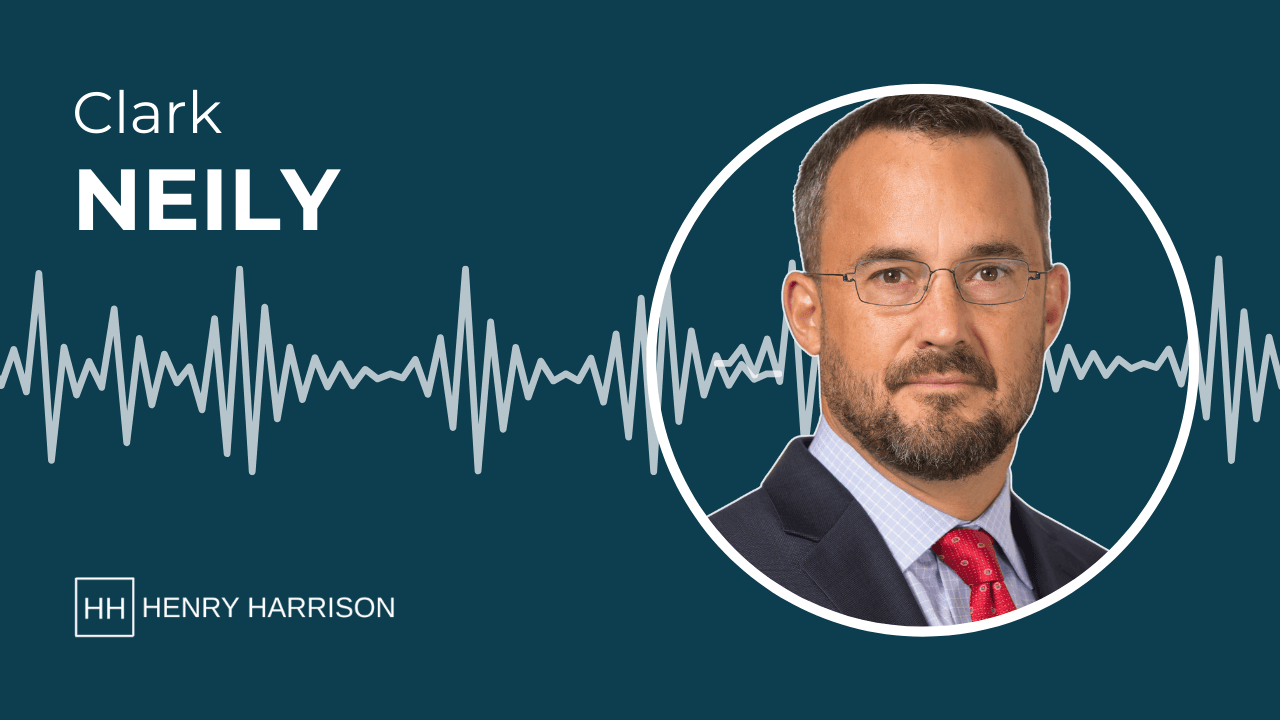
Clark Neily
Constitutional Law, Criminal Justice, and the Case for Limited Government
A grounded conversation on liberty, legal strategy, and how reform actually happens
Clark Neily explains how libertarian legal strategy moves from ideas to courtrooms—and why the criminal justice system became his central focus after witnessing civil forfeiture firsthand. Henry and Clark discuss the mission of the Cato Institute, the Institute for Justice, and what it takes to challenge government power on an uneven playing field while staying anchored to constitutional limits.
Watch / Listen
About This Episode
Clark Neily is Vice President of Legal Studies at the Cato Institute and a longtime constitutional litigator who has spent his career challenging government overreach. In this episode, Henry Harrison and Clark unpack what a think tank like Cato does in practical terms—developing policy ideas that prioritize personal autonomy, limited government, and peaceful civic life—and how those ideas translate into real-world change.
Clark also walks through his earlier work at the Institute for Justice, a public interest law firm that challenges unconstitutional government policies in court. A turning point for him came through civil forfeiture cases, where he saw how casually government power could be exercised against ordinary people. That experience pushed him to focus more deeply on criminal justice reform, including issues like overcriminalization, coercive plea bargaining, and police accountability.
They also discuss Clark’s role as an educator, teaching law students how to litigate against government institutions that often benefit from special procedural advantages. The conversation closes on a forward-looking note: regardless of today’s polarization, Clark argues the Constitution remains a durable framework—and a practical tool—for restoring the balance between individual liberty and government power.
Key Insights
Clarify your mission: ideas (think tanks) and enforcement (litigation) play different roles in reform.
When assessing policy, measure the “government footprint” and ask where autonomy should remain with the individual.
Civil forfeiture is a case study in how power can be misused—even without a criminal conviction.
Criminal justice reform requires system-level thinking: incentives, process, and accountability matter more than slogans.
Strategic litigation works best when the case context supports the principle being argued—not just the headline issue.
Teaching advocacy means teaching reality: government often has structural advantages in court that must be anticipated.
Sustainable change comes from combining legal strategy, policy work, and public education.
A clear constitutional framework can be a practical guide for rebuilding trust and stability over time.
Episode Transcript
This transcript has been lightly edited for clarity and readability. Filler words were removed, sentence structure was improved, and the conversation was formatted for easier reading while preserving the original meaning and tone.
Henry Harrison:
Today we’re very fortunate to have on the show my good friend Clark Neily.
I’m reading his bio because it’s extensive: he’s Vice President of Legal Studies at the Cato Institute. His interests include constitutional law, overcriminalization, coercive plea bargaining, police accountability, and gun rights.
He’s been at the Cato Institute since 2017. Before that, he had a long history with the Institute for Justice, private practice, and academia.
Clark, welcome to Entrepreneurs, Business, and Finance.
Clark Neily:
Hi, Henry. Good to be with you.
What Is the Cato Institute?
Henry Harrison:
For people who aren’t as familiar, give us an idea of what the Cato Institute is, what a think tank does, and how that works inside the Beltway.
Clark Neily:
The Cato Institute is a libertarian think tank based in Washington, D.C. We were founded in 1977.
Our goal is to develop policy proposals that promote:
Limited government
Individual freedom
Personal autonomy
Peaceful interaction at home and abroad
The core idea is that individuals make better decisions about their lives than collective entities, including governments.
The Constitution was designed to maximize individual decision-making and minimize government overreach. At Cato, we believe the country has drifted from that vision.
So we analyze policies and propose reforms to bring things back toward a framework where individual liberty is preeminent.
From the Institute for Justice to Cato
Henry Harrison:
You’ve worked at both the Institute for Justice and Cato. What led you from one to the other?
Clark Neily:
The Institute for Justice (IJ) is also libertarian, but it’s structured differently.
Cato is a think tank—we generate ideas and proposals
IJ is a public interest law firm—it challenges government actions in court
I spent 17 years at IJ as a constitutional litigator, focusing on:
Occupational freedom
Property rights
Free speech
Over time, I became deeply concerned about the criminal justice system, especially after working on civil forfeiture cases.
Civil forfeiture allows the government to seize property—cars, homes, bank accounts—without proving a crime.
What troubled me most was how casually that power was sometimes exercised. That led me to ask: if the system can be careless with property, is it more careful when prosecuting people?
I concluded that often, it isn’t.
That realization led me to Cato, where I focused on criminal justice reform before moving into a broader leadership role overseeing legal studies.
Policy Work and Elections
Henry Harrison:
Cato is a nonprofit that contributes to public policy. Can you give an example?
Clark Neily:
After the 2020 election, gaps in the electoral process became clear.
My colleagues and I worked on proposals to:
Improve clarity in election procedures
Reduce opportunities for disputes or bad-faith challenges
Support smoother transitions of power
In a country this large, perfection isn’t realistic. The goal is minimizing systemic risks and ensuring confidence in results.
We contributed to reforms that helped improve the process moving forward.
The Heller Case
Henry Harrison:
One of the highlights of your career is the Heller case. Can you summarize it?
Clark Neily:
District of Columbia v. Heller (2008) addressed a long-standing constitutional question:
Does the Second Amendment protect an individual right, or only a collective militia-related right?
For years, courts avoided giving a clear answer.
We brought a carefully designed case challenging Washington, D.C.’s restrictive gun laws, which effectively banned handguns and required other firearms to be inoperable.
In a 5–4 decision, the Supreme Court held that the Second Amendment protects an individual right to possess a firearm for self-defense in the home.
For us, the case wasn’t primarily about guns—it was about ensuring that no part of the Bill of Rights is effectively ignored.
Influence of Family and Service
Henry Harrison:
You’ve always had a strong sense of purpose. I know your father played a role in shaping that.
Clark Neily:
Yes. My father worked at NASA during the Gemini and Apollo programs.
He was involved in procedures critical to missions—like the rendezvous process that allowed astronauts to return safely from the moon.
That level of responsibility at a young age is something I’ve always found inspiring.
We used to joke about whose career was more impressive—and I always said nothing I do compares to helping put a man on the moon.
Teaching and Public Interest Litigation
Henry Harrison:
You’ve also taught law. What did you focus on?
Clark Neily:
I taught Public Interest Litigation—how to challenge government actions in court.
One key lesson is that litigation against the government is not an even playing field.
The government often has:
Special procedural advantages
Legal defenses not available to others
Institutional familiarity with courts
The goal is to understand those dynamics and develop strategies that work within that reality.
Final Thoughts
Henry Harrison:
That’s a great place to wrap up. I always learn something when I talk to you, Clark. Thank you for coming on.
Clark Neily:
Thank you, Henry. My pleasure.
I’ll leave your audience with one thought:
We’re living in a time of polarization and uncertainty, but we still have one of the strongest constitutional systems in the world.
The government doesn’t always respect its limits, but we have mechanisms to push back.
As Frederick Douglass called it, the Constitution is a “glorious liberty document.”
We shouldn’t forget that.
Henry Harrison:
Terrific. Thank you very much. Talk to you soon, Clark.
Clark Neily:
Sounds great.
Enjoyed This Episode?
Subscribe to the podcast and never miss an episode. Available on all major platforms.