Don Williams
Don Williams on Sales That Feels Natural: Build a Company, Not a Job
The fastest path to business growth is removing “sales prevention” and delivering a better buying experience
Don Williams breaks down what actually drives business growth: clear messaging, human-to-human relationships, and a sales process that removes friction instead of creating it. He shares founder lessons from nearly four decades in business, including why “ringing the cash register” matters early, how to define a real value proposition, and how mission-led leadership makes better decisions.
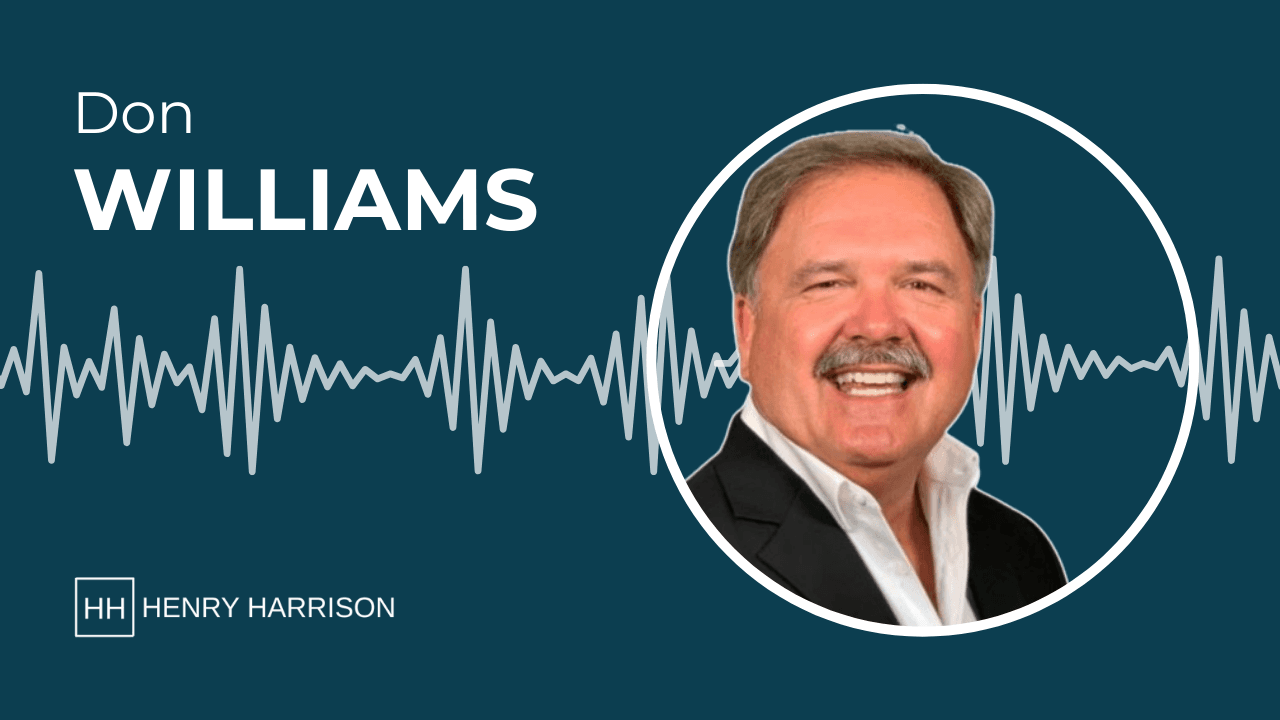
Watch / Listen
About This Episode
Don Williams has spent nearly four decades in entrepreneurship, but his origin story isn’t a profit fantasy—it’s a practical decision to control his own path. Raised around hard work and responsibility, he learned early what effort costs—and what kind of life he didn’t want. That clarity pushed him toward building businesses where results are measurable: revenue, relationships, and repeatable sales systems.
In this conversation with Henry Harrison, Don explains why most companies struggle with sales even when their product is strong. The issue isn’t effort—it’s friction. He describes “sales prevention” as the unnecessary steps, confusion, and misalignment that keep prospects from doing what they already want to do: buy.
Don also reframes value proposition in a way entrepreneurs and executives immediately understand: value isn’t what you sell—it’s the gap between what it costs you and what it’s worth to the customer. When that gap is big enough, customers don’t need persuasion. They need clarity and a next step.
Beyond tactics, Don emphasizes leadership and mission. He shares how defining purpose brought focus to his time, priorities, and business decisions—and why “helping others help others” creates a larger ripple across teams, customers, and communities.
This episode is a masterclass in practical sales strategy, founder discipline, and building growth with integrity.
Key Insights
Early-stage founders don’t need perfection—they need revenue; learn to “ring the cash register” first.
Don’s core belief: people buy from people, not companies; relationships drive sales outcomes.
“Sales prevention” is real: unnecessary steps and unclear processes keep buyers from purchasing.
Strong selling feels natural—buyers don’t want pressure; they want permission and clarity.
A real value proposition creates a gap so compelling the customer gladly pays the price.
See the sale from the buyer’s perspective: give them what they want, when they want it, how they want it.
Don’s decision filter: is it good for the customer, the team, the company, the partners, and the world?
Build a company, not a job—plan to delegate early so the business can run without you.
Episode Transcript
This transcript has been edited for clarity, readability, and flow. Minor adjustments have been made to remove filler words and improve structure while preserving the original meaning and intent of the conversation.
Henry Harrison:
Well, hello, Don.
Don Williams:
Hey, Henry. How are you?
Henry Harrison:
Fantastic. This is Don Williams. Thank you for coming on Entrepreneurs, Business and Finance.
Don and I have been friends—I think it’s been eight or nine years now. Time flies.
We met through mutual friends in Entrepreneurs’ Organization, where Don has been a leader, and I’ve also been involved.
Don is a keynote speaker, consultant, published author, and repeat entrepreneur. He has a 38-year-old business that he started very young.
He also runs Don Williams Global, a performance-based sales consulting firm, and hosts the Proven Entrepreneur podcast.
Don helps a lot of people—and has helped bring in many speakers over the years, including me.
Let’s go back. You’ve had tremendous success and global reach. How would you describe what you do?
Don Williams:
At a simple level, I help people.
If I want to sound sophisticated, I’d say I’m a consultant—but really, I help people ring the cash register.
I don’t care what they sell—I can help them sell more of it, faster and easier.
And I’ll put my money where my mouth is. If someone is hesitant, I’ll bet with them.
One of my core beliefs is that people don’t have relationships with companies—people have relationships with people.
My superpower is words. I speak, I write, I podcast—and after 38 years and multiple businesses, I’ve seen a lot.
I can help in many areas, but what I enjoy most is helping businesses grow revenue.
Henry Harrison:
Were you always entrepreneurial?
Don Williams:
Not in the typical sense.
My dad was an engineer, my mom was a bookkeeper, and my grandparents were wheat farmers.
My first job was driving a tractor during harvest. That taught me two things:
What hard work is
That I didn’t want to be a farmer
I became an entrepreneur largely because I didn’t like authority.
That’s more common than people admit. Many entrepreneurs aren’t chasing money—they’re chasing independence.
I worked for someone and helped grow his business significantly. Eventually, I earned a partnership through sweat equity—but then he didn’t honor the agreement.
So I became his competitor.
I was completely unprepared—I didn’t know what a P&L or balance sheet was. But I knew how to bring money in.
And if you only know one thing starting out, that’s the one to know.
Henry Harrison:
That solves a lot of problems.
Don Williams:
Exactly.
If you can generate revenue, you can fix almost anything else.
You can hire experts for finance, operations, whatever you need.
Selling the right way is actually natural. People don’t want to be sold—they want permission to buy.
When you do it wrong, it’s hard. When you do it right, it’s easy.
Henry Harrison:
That resonates. Early in my career, I learned that people don’t want to be sold—they want to be helped and educated.
Don Williams:
That’s exactly right.
And while there’s been success, there have also been hard times.
Over time, I realized something important: you don’t invent your mission—it’s already in you.
My mission is to help others help others.
Helping people is great—but helping people who help others creates a much bigger ripple.
That mission guides everything I do.
Henry Harrison:
You also have a framework—“YOU and ME.” Can you explain that?
Don Williams:
Yes.
YOU:
Y – You first: I put the client first
O – Outstanding effort: I give my best
U – Understanding: The more we understand, the better we do
ME:
M – Mission-oriented: We need a clear goal
E – Enthusiasm: Passion—not volume, but purpose
And then there’s IASM: “I Am Sold Myself.”
If you want to influence others, you have to believe in what you’re selling.
Henry Harrison:
That clarity helps guide decisions.
Don Williams:
It does.
We all get 86,400 seconds a day. That framework helps me decide how to use mine.
Henry Harrison:
You’ve had a company running successfully for years, but you also reached a turning point where you wanted more.
Don Williams:
Yes.
I still love that business—but it doesn’t need me much anymore.
Recently, I’ve been traveling—Singapore, Wichita, Charlotte, Baltimore—all within a few weeks.
I live in gratitude. Even tough travel days are a blessing.
Henry Harrison:
You often say: don’t build a job—build a company.
Don Williams:
Exactly.
Early on, you do everything—and that’s fine.
But if you design the business to always depend on you, you’ll never escape it.
Build something that can run without you.
Henry Harrison:
Can you share a couple of success stories?
Don Williams:
Sure.
Example 1 – Solopreneur (EOS Implementer):
He had four clients at $4,000 per day.
I asked why not charge $10,000. He said that’s not how it’s done.
We built him to 28 clients, and he eventually signed his first $10,000/day engagement.
That’s success—helping him help others.
Example 2 – Large Company (2,100 Employees):
Their B2B division was struggling.
We didn’t add leads or marketing—we fixed internal processes.
We removed “sales prevention” and doubled sales in eight weeks.
Henry Harrison:
That’s powerful.
Don Williams:
Most businesses don’t have a lead problem—they have a process problem.
Also, very few can clearly articulate their value proposition.
Value is the difference between what something costs and what it’s worth.
Your value should be so strong that customers want to give you their money.
Henry Harrison:
That’s a great insight.
Don Williams:
And I’ll leave you with this:
If you:
Sleep in a bed
Have clean water
Were born in the developed world
Have an education
You’ve already won the lottery.
So go help somebody.
And run decisions through this filter:
Is it good for the customer?
The staff?
The company?
Vendors?
The organization?
The world?
If yes, it’s probably a good decision.
It’s good business to do good.
Henry Harrison:
That’s a perfect place to end.
If someone wants to connect with you?
Don Williams:
Go to Don Williams Global, or email me directly:
don@donwilliamsglobal.com
It may take a little time, but I’ll respond.
Henry Harrison:
Don, thank you for coming on and sharing your wisdom.
Don Williams:
Henry, thank you. I’m grateful to be here—and I look forward to seeing you soon.
Henry Harrison:
Likewise. Thanks again.
Connect with Don Williams
Enjoyed This Episode?
Subscribe to the podcast and never miss an episode. Available on all major platforms.