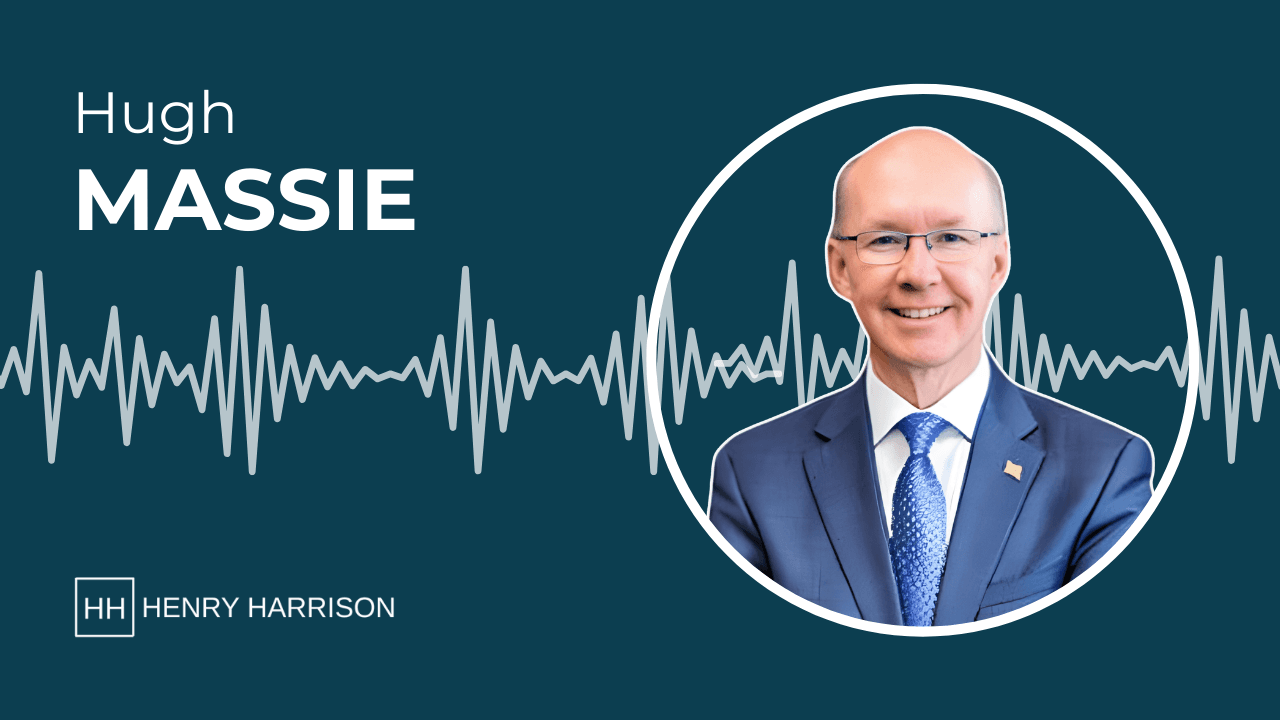
Hugh Massie
Hugh Massie on Behavioral Data, AI Scanning, and Personalization at Scale
A founder-level conversation on using behavioral intelligence to strengthen teams, improve client engagement, and make better decisions when it matters most.
Hugh Massie joins Henry Harrison to unpack how behavioral data can improve leadership, communication, and decision-making—especially under pressure. They explore DNA Behavior’s shift from traditional psychometric profiling to AI-driven digital scanning, and what personalization looks like when organizations can “see” behavioral patterns at scale.
Watch / Listen
About This Episode
Hugh Massie is the Executive Chairman and Founder of DNA Behavior, a behavioral data analytics company he founded in 2001—years before “behavioral economics” became mainstream in business conversations. Hugh built his own psychometric system to measure not just talents and strengths, but how people behave with money and make decisions under pressure.
In this episode, Henry Harrison and Hugh discuss why personalization is more than a customer experience buzzword. Hugh explains how leaders, advisors, and teams often miss the mark in communication—not because they lack intent, but because people process risk, loss, and motivation differently. The result is uneven trust, inconsistent engagement, and avoidable conflict.
Hugh also shares a major strategic pivot: moving from a questionnaire-based model (high accuracy, but friction) to an AI-enabled digital scan that can build behavioral insights from public signals—opening the door to behavioral “heat maps” across entire organizations. That shift has helped DNA Behavior scale its database dramatically and reposition the company around behavioral intelligence as a new layer of data—alongside demographics and transactions.
For entrepreneurs and executives, the takeaway is practical: culture and trust start at the top, and behavioral insight can become a strategic asset for hiring, leadership, sales, and client outcomes.
Key Insights
Personalization works best when you understand the person first—strategy and money decisions follow from that.
People share the same biases (like loss aversion), but not at the same intensity; “one-size-fits-all” nudges leave value on the table.
Under pressure—often driven by money and relationships—people revert to hardwired behavior, which changes communication and decisions.
AI scanning can reduce friction by generating behavioral insights without requiring everyone to complete a questionnaire.
Use behavioral “heat maps” to understand teams, advisors, or client ecosystems and improve matching, lead routing, and engagement.
For high-stakes decisions (partners, leadership conflict), prioritize the higher-accuracy full profile over a scan.
Trust and psychological safety must start at the top; leaders should share first to set the tone.
Protect the “soul” of your company—your differentiator is often cultural, not technical.
Episode Transcript
This transcript has been edited for clarity, readability, and flow. Filler words, repetitions, and minor grammatical inconsistencies have been removed, and formatting has been adjusted for easier reading. The substance, intent, and meaning of the original conversation have been preserved.
Henry Harrison:
I want to welcome to the show Mr. Hugh Massie—Executive Chairman and Founder of DNA Behavior.
Entrepreneurs, Business, and Finance is always our focus, and we’re fortunate to have Hugh on because he’s a repeat entrepreneur.
Welcome, Hugh.
Hugh Massie:
Great to be with you, Henry. I’m really excited for the discussion.
Background & Career
Henry Harrison:
You’ve had a long entrepreneurial journey. You’re focused on DNA Behavior full-time, but you’ve also:
Founded a wealth management company
Run a venture capital firm
Spent about 10 years at Arthur Andersen
You’ve also been deeply involved in Entrepreneurs’ Organization globally.
Tell us what you’re doing now.
What DNA Behavior Does
Hugh Massie:
DNA Behavior is a behavioral data analytics company.
We built our own psychometric system—similar to:
DISC
StrengthsFinder
Kolbe
Myers-Briggs
These tools measure:
Talents and strengths
How people think and behave
How people relate to money
The money component came from my wealth management background. I wanted to hyper-personalize financial advice—understanding the person first, then aligning strategy to their behavior and goals.
Behavioral Economics & Personalization
Hugh Massie:
Behavioral economics tells us people have biases—like loss aversion—but those biases vary by individual.
The key insight is:
People behave differently under pressure
Financial stress often triggers “true” behavior
You might see one version of a person socially—and a completely different version when money or risk is involved.
That led to my core mission:
Help people become financially self-empowered through understanding behavior.
Evolution with AI
Hugh Massie:
Originally, people completed a behavioral profile manually:
Took ~30 minutes (now ~10.5 minutes)
But there’s still friction—people have to do it.
Two years ago, we asked:
What if we could scale to a billion people?
The answer was AI.
We built a digital scan that uses public data to generate behavioral insights without requiring manual input.
Today:
We have ~275 million people with behavioralized data
That number continues to grow
We’ve shifted from:
Consulting & coaching
To:
Behavioral data infrastructure
This is what we call behavioral intelligence—layering behavior on top of demographic and transactional data.
Organizational Insights
Henry Harrison:
I saw your dashboard—like a heat map for organizations.
Hugh Massie:
Exactly.
We can:
Map leadership teams
Analyze employee behavior
Align advisors with clients
For example:
Match advisors to clients based on behavioral fit
Route leads more effectively
Improve communication and outcomes
Previously, this required thousands of manual profiles. Now it can be done digitally at scale.
Real-World Example
Henry Harrison:
Give us a practical example.
Hugh Massie:
Two business partners:
One sales-driven and aggressive
One operational and risk-averse
They grew to $5M revenue but hit conflict when expanding:
Sales partner wanted growth and financing
Operations partner feared risk and guarantees
The conflict escalated.
Through behavioral profiling, they:
Understood each other’s wiring
Recognized the root cause of conflict
They adjusted their structure to meet both needs—saving the partnership.
That’s why we measure both:
Talents
Money behavior
They are inseparable.
How “Scanning” Works
Henry Harrison:
Explain the scanning process.
Hugh Massie:
Two approaches:
1. Self-Profile
Takes ~10.5 minutes
~97% accuracy
2. Digital Scan
Uses public data (career history, content, signals)
~70–75% accuracy
The scan:
Reduces friction
Provides quick insights
But for high-stakes situations (like partners), we recommend full profiling.
Business Impact
Hugh Massie:
Most people communicate based on their own wiring.
That creates:
Misalignment
Weak trust
Lost opportunities
Behavioral insights help:
Adapt communication
Increase engagement
Improve decision-making
A salesperson may connect with 40% of prospects naturally—but struggle with the other 60%. Behavioral intelligence helps close that gap.
Company Structure
Henry Harrison:
Where is your team based?
Hugh Massie:
Leadership: Atlanta
UX/Engineering: Pakistan
Database: India
Analytics: Sri Lanka
Additional teams: Philippines, Australia
We’re global—but building more leadership presence in Atlanta for culture.
Culture & Leadership
Hugh Massie:
Our culture is built on three principles:
Know people
Engage people
Grow people
Leaders must go first.
If a CEO won’t:
Complete a profile
Share it transparently
We won’t engage.
Trust and openness are essential to making this work.
Privacy Considerations
Henry Harrison:
Privacy is a concern for many.
Hugh Massie:
Yes, especially in low-trust environments.
We don’t store sensitive data like:
Financial accounts
IDs
We focus on behavior—not personal records.
The key is how the insights are used:
They must build trust—not harm it
Personal Journey
Henry Harrison:
Were you always people-focused?
Hugh Massie:
Interestingly, I’m naturally:
Results-driven
Numbers-oriented
Entrepreneurial from a young age—always building things.
Arthur Andersen was a practical starting point—but entrepreneurship was always the goal.
I had to develop empathy over time.
A key moment was feedback in Singapore—I learned I needed to adapt my communication style. Behavioral insights helped me grow.
Leadership Philosophy
Hugh Massie:
Leadership requires balancing:
Results
Relationships
Key traits:
Compassion
Courage
Accountability
You don’t have to be soft—but you don’t have to be harsh either.
Great leaders:
Set people up for success
Put them in the right roles
Provide tools and support
Closing
Henry Harrison:
If someone wants to connect?
Hugh Massie:
Visit the website or find me on LinkedIn—Hugh Massie in Atlanta.
Henry Harrison:
I admire what you’ve built. Thanks for coming on the show.
Hugh Massie:
Thank you, Henry. I enjoyed the conversation and look forward to staying in touch.
Enjoyed This Episode?
Subscribe to the podcast and never miss an episode. Available on all major platforms.