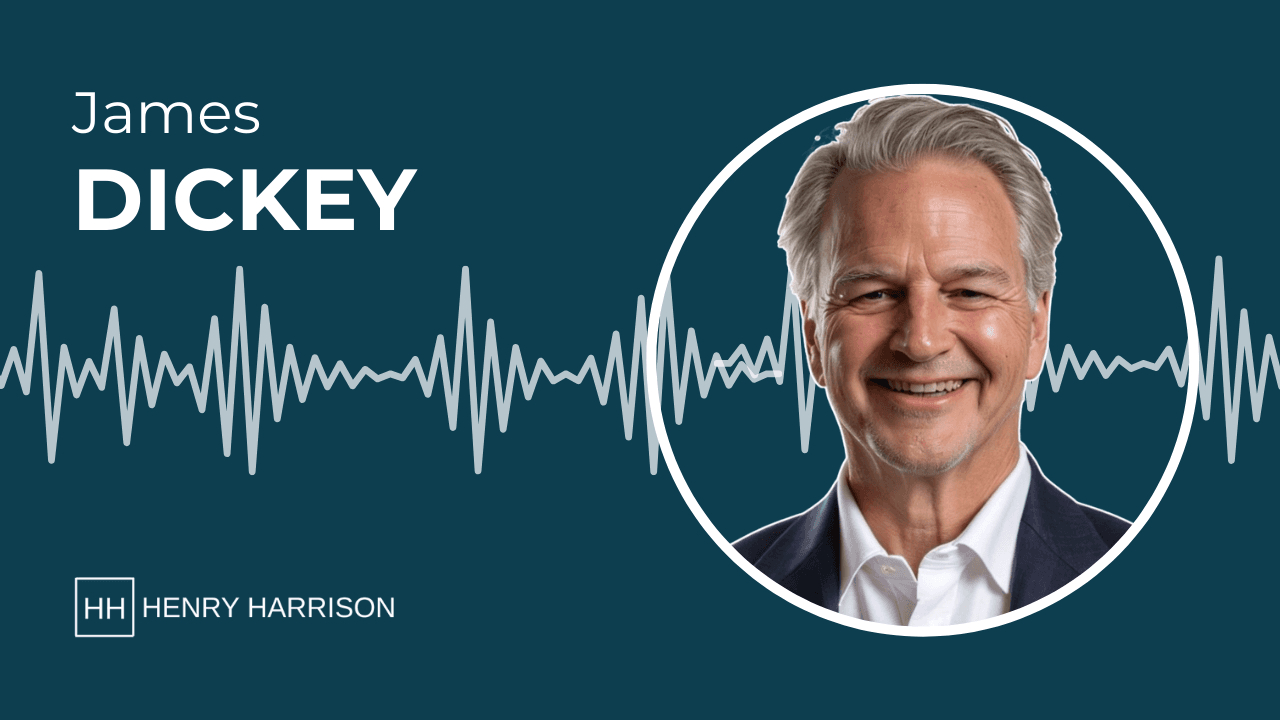
James Dickey
Founder Lessons in Leadership, Strategy, and Long-Term Reputation
How James Dickey navigated startups, regulation, and mission-driven leadership with integrity as the throughline
James Dickey shares a founder’s view of building a career across startups, corporate leadership, and mission-driven work—without losing focus on impact and integrity. He and Henry discuss entrepreneurship, leadership, regulatory strategy, and what it takes to scale change through trust, networks, and long-term credibility.
Watch / Listen
About This Episode
James Dickey has built an unusually broad career: insurance and compliance, corporate product leadership, multiple startups, political leadership, consulting, and now nonprofit executive leadership. In this conversation with Henry Harrison, James explains how each chapter was driven by the same question: where can I create the most positive impact?
James describes how early exposure to school choice shaped his work today as Executive Director of Liberty for the Kids, advocating for universal school choice in Texas. He also details his time in regulated insurance markets and how that experience led to founding Insbridge—software designed to reduce compliance risk and modernize pricing and documentation workflows for major carriers. The story becomes a practical founder case study in enterprise sales, distribution challenges, and the reality that the best product doesn’t always win.
Henry and James also explore leadership as reputation over time, the compounding effect of integrity in business, and how career “nonlinear” paths can still produce strategic momentum—especially when anchored in strong relationships, disciplined decision-making, and clear priorities.
For entrepreneurs, investors, and executives, this episode connects business growth, regulatory strategy, and leadership ethics into a cohesive playbook for long-term credibility.
Key Insights
Define “impact” before choosing your next move—then evaluate opportunities through that lens.
In enterprise startups, distribution and internal politics can outcompete product quality. Plan for it.
Reduce regulatory risk by aligning what you document with what your systems actually execute.
Career compounding matters: reputation, referrals, and trust accumulate like capital over time.
Build complementary partnerships—skill overlap is less important than fit and coverage.
When advocacy is the goal, combine legislative strategy with constituent-driven grassroots pressure.
Don’t pursue credentials for the paper; pursue them for specific capability gains you’ll apply.
Episode Transcript
This transcript has been lightly edited for clarity and readability. Filler words were removed, and sentences were tightened while preserving the original meaning and conversational tone.
Henry Harrison:
Today, I’m very fortunate to have James Dickey on the Henry Harrison Podcast—Entrepreneurs, Business and Finance.
James has been a friend for a long time. We met in the late ’90s through an entrepreneur group, and we were in a forum together—an informal board of directors that meets monthly, takes an annual trip, and talks about the most important parts of life.
James now lives in Austin, so we don’t see each other as often, but we’ve stayed connected over the years.
James, welcome.
James Dickey:
Hello, Henry. It’s great to be with you. I’m glad you’re doing the podcast—this is a great opportunity, and it’s always fun to connect.
Henry Harrison:
One memory I have with you and your family—there are plenty—is going to your house around Christmas. My background is starting to look like that season.
Your wife’s decorating was on another level. Every room had a theme. Some people do one room; your whole house felt like an experience. Olga and I loved that tradition for many years.
James Dickey:
We had so much fun doing that. Linda still does it. She has several trees, each with a different theme. People love it, and she loves it. I’m happy to support it.
Henry Harrison:
You’ve had a diverse career. I know what you’re doing now, and I’ve watched what you’ve done over time, but it’s hard to summarize from memory.
You’re involved with Liberty for the Kids and the C5 Youth Foundation. You also had JD Dickey, a consulting business, for several years. Where are you focused today?
James Dickey:
Right now, I focus almost all my effort on Liberty for the Kids.
It’s a grassroots organization advocating for universal school choice for parents and kids in Texas. I personally benefited from school choice. My dad took a second job to pay for my private school tuition. Later, I went back to public school and was fortunate to attend a magnet school. I have no doubt that without that magnet school, I wouldn’t have gone to Stanford or had the education and life I’ve had.
It has always bothered me that so many kids—especially those from the same communities—don’t have the same options. With strong support from the Governor and Lieutenant Governor, this is the best moment we’ve had in Texas to advance universal school choice, and I’m excited to be part of it.
This is also a natural evolution of what I’ve been doing the last few years: political and grassroots activism, consulting for companies dealing with regulatory and government affairs, and volunteer leadership.
I’m the chair of trustee affairs for C5 Texas, which mentors students from 7th through 12th grade to ensure they’re college-ready, community-oriented, and prepared to serve and lead. C5 has been doing this for 20 years. We now have kids in the program whose parents went through it. That’s an incredible legacy.
I also volunteered with the Interstate Oil and Gas Compact Commission on regulatory affairs, and I’ve done a lot of campaign and candidate work. Liberty for the Kids feels like the perfect culmination of all of that.
Henry Harrison:
We talk about business, entrepreneurship, and finance on this show, and it’s not a political show. We welcome guests from all walks of life.
But you do have a strong business and finance background. You were Chairman of the Republican Party of Texas, you ran a consulting firm, and you’ve helped organizations navigate federal, state, and local regulations. Before that, you were an entrepreneur in a different way—starting with insurance. Is that right?
James Dickey:
Yes. I started in insurance doing marketing and sales to agencies. I didn’t sell to the public. I recruited agents and helped them grow their business—both with us and generally.
Within a couple of years, I moved into product management and compliance. Insurance is regulated by the 50 states, so I worked with regulators across the country. When I was at Citigroup’s insurance operation, I led new product development, so we were pushing the envelope on product design and how we could operate within differing regulations.
One limiting factor everywhere was technology. Many insurance companies had old systems. I found two great developers. I understood the business and the problem, and we partnered to build a product that let insurance professionals change pricing algorithms, generate compliance documents automatically, and ensure the system did exactly what regulators were told it would do.
Manual handoffs between compliance documentation and programmers often caused mismatches, which could create major compliance issues and fines. Our software reduced that risk and helped carriers build more sophisticated pricing.
We started Insbridge, and later sold it. It became part of Oracle’s insurance operation. Oracle Insbridge is still around more than 20 years later.
Henry Harrison:
That was a true startup.
James Dickey:
It was. We were mostly bootstrapped, with a small friends-and-family round. We had all the early startup realities.
There were road trips where the three co-founders split one hotel room to save costs while pitching billion-dollar companies.
And we learned quickly that the best product doesn’t always win. Distribution matters. Getting through organizational hurdles matters.
A lot of our competition was internal programmers. I remember one company where we offered our system for $300,000 a year. The CIO convinced the board to spend $2.5 million building it internally with an 18-month timeline. Two years later, we were on version four of our product, and they still hadn’t delivered theirs—and they’d spent more than $2.5 million. That happened frequently.
We grew to about 15 people by the time I left. We made it work, and having a strategic buyer ultimately mattered.
Henry Harrison:
Looking at your background, you’ve worked in big corporations, built startups, served on boards, led in politics, consulted, and now lead a nonprofit.
You’ve made a lot of moves—often long ones, not short stints. People might wonder how you chose those paths. I’d call you a serial entrepreneur and someone who follows opportunities and mission.
James Dickey:
It’s a strange path, and it’s not necessarily what I recommend. I have three kids ranging from 20 to 30, and I tell them: pick a field and stick with it. Compounding matters in careers like it matters in finance.
For me, I’ve always looked for where I could have a positive impact. With Insbridge, that was modernizing an industry. At Citigroup, I led a team that produced strong results—millions in income growth per quarter.
When I moved into political work, it wasn’t financially the best move, but it was meaningful. I wanted to recruit better candidates and help build stronger leadership. I was proud of that work.
Henry Harrison:
I always thought you just wanted trips to the Oval Office to meet the President. I’m kidding. But I’ve always known you care about impact.
Many guests on this podcast follow passion and believe they can make a difference. My dad used to say: find something you love—or at least like—because you’ll spend a large portion of your life doing it. Fear holds a lot of people back from making the leap.
Did you ever hesitate before starting Insbridge, JD Dickey, or making career changes? What got you over the hump?
James Dickey:
Some of it is prayer and discernment. Often the next step becomes obvious.
With Insbridge, I’d seen the problem repeatedly. Then I met developers who could make the vision real. We all got excited—it felt clear.
I’m also very blessed. Linda and I have been married 35 years. Having a supportive spouse makes a huge difference in being able to take risks.
When we started the insurance operation later, the timing aligned for both partners, and our skills complemented each other. It made sense.
With JD Dickey, I wasn’t even sure what it would become. But people called me and asked for help based on my work at the party, and they became clients. That created momentum.
With Liberty for the Kids, I met the founder, understood the mission, met the board, and it was clear this was work worth doing for the next decade.
Henry Harrison:
What led you to get your MBA at Baylor?
James Dickey:
I finished it right before we met. It was a two-year program. We moved to Dallas in 1992, and we had just had our first child. I felt like if I didn’t do it then, I wouldn’t do it.
I thought it would help with the corporate path I was on. I got my Citigroup role before finishing the MBA. Soon after finishing, I moved into a better role at a smaller company.
The MBA helped me feel more confident with financial analysis and acquisition evaluation, but it’s hard to say whether it was required.
I’ve told my kids: don’t do it just for the paper. Do it if you’ll get something specific out of it.
Henry Harrison:
I did mine at SMU after starting my first business. I wanted to learn outside my lane, and it helped me.
Fun fact: you have more LinkedIn connections than anyone I’ve seen. And you’re proficient in sign language. Want to share that?
James Dickey:
My brother is deaf, and my son is hard of hearing. I learned sign language as a kid and still use it when I can.
Henry Harrison:
This is one of the best parts of doing the podcast. You get to interview friends and ask questions you might not ask in everyday life.
Before we wrap, what’s it like being an executive director of a nonprofit focused on helping kids?
James Dickey:
It’s a wonderful challenge and a good culmination of my experience.
The job includes fundraising, working with legislative efforts to pass good bills and keep them good through amendments, and organizing grassroots activism so legislators hear from their constituents.
Legislators do listen to voters. When constituents speak up, it gives good legislators the confidence to do the right thing, and it pressures others to stay aligned with what voters want.
It’s also worth saying: you don’t need to be a professional to have impact. Anyone can call their representative as a constituent. It matters.
And Henry, it’s been great knowing you for 25 years. Even when we’re apart, we’ve stayed in touch. I value that.
Henry Harrison:
James Dickey extraordinaire. Thanks for coming on the podcast.
James Dickey:
My pleasure.
Connect with James Dickey
Enjoyed This Episode?
Subscribe to the podcast and never miss an episode. Available on all major platforms.