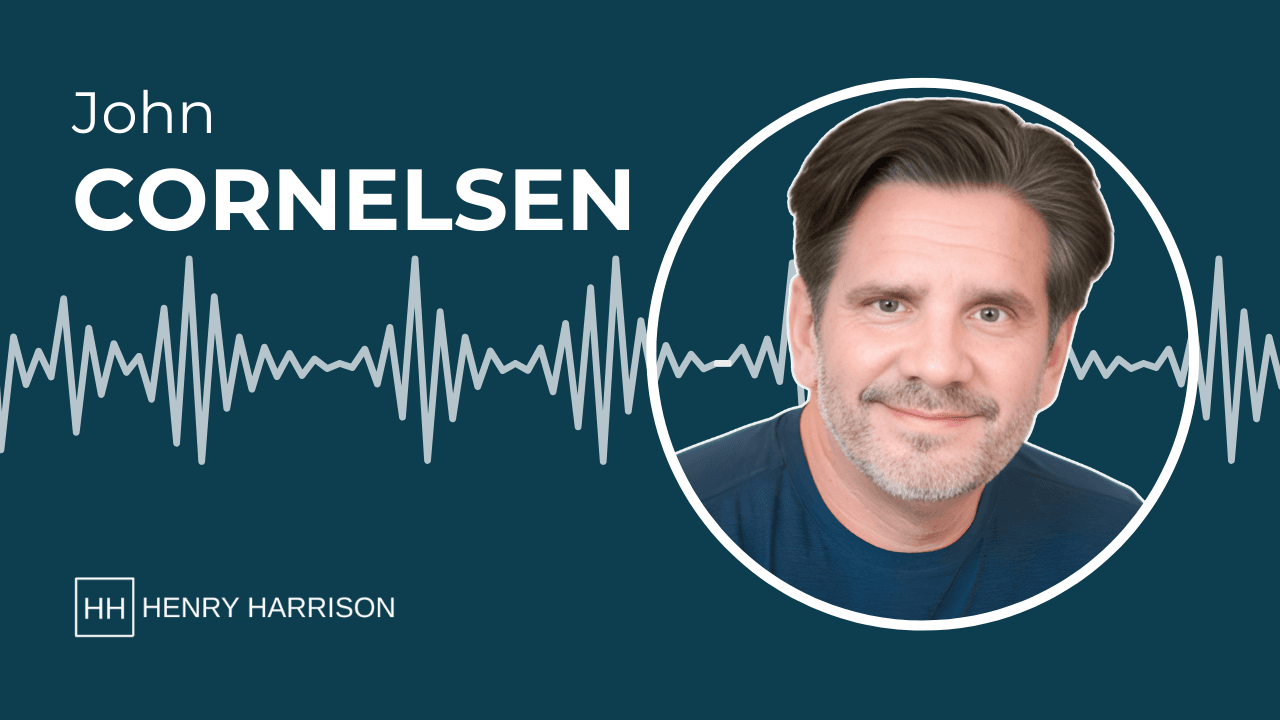
John Cornelsen
Entrepreneurship Built on Connection: Civil Engineering, Community, and the Business of Belonging
Why relationships—and intentionality—are John Cornelison’s operating system
John Cornelison’s entrepreneurial story starts early—from childhood newspaper hustles to building a civil engineering firm that shapes real estate development across Texas. In this conversation, John breaks down how relationships became his business edge, why he built Indigo and Juggle to fight social isolation, and what he’s learned about leadership, partnership, and personal responsibility along the way.
Watch / Listen
About This Episode
John Cornelison and Henry Harrison go back more than two decades through EO (Entrepreneurs’ Organization), long before John launched Evolving Texas. John shares how early experiences—running a lawn business as a teen, working around planning and civil engineering through his dad, and taking a leap to California at 17—shaped his confidence, work ethic, and appetite for building.
At Evolving Texas, John’s team designs the infrastructure behind development: site planning, density strategy, and land development engineering for residential and commercial projects. He explains how years of complex national work—like designing for large retailers—trained him to solve hard problems under real-world constraints.
But John’s entrepreneurship isn’t limited to engineering. He built Indigo as a community-centered yoga studio and created Juggle to help people become more intentional about relationships in a world where loneliness and social isolation are rising.
This episode is a founder’s view of business growth, leadership, and the long game: building companies that work—and building a life that stays connected to what matters.
Key Insights
Early “small” ventures build the core skill most founders overlook: talking to people and building trust.
Mentorship accelerates growth—especially when you’re willing to work harder than the job requires.
In professional services, your product is problem-solving under constraints, not just deliverables.
Strong partnerships work when roles are clear—one person drives craft, the other drives business.
Community is a business moat when it’s authentic: create a place people feel they belong.
Technology should drive real connection, not passive engagement—design for intentional relationships.
Leadership improves when you assume responsibility for the environment you create.
Growth without reflection increases friction—look back, learn, then scale the next phase.
Episode Transcript
This transcript has been lightly edited for clarity and readability. Filler words were removed, sentence structure improved, and formatting adjusted while preserving the original meaning and conversational tone.
Henry Harrison:
Welcome to the podcast, Entrepreneurs, Business and Finance. Today we’re fortunate to have an entrepreneur with us and a good friend of mine—John Cornelison.
We’ve known each other for at least 20 years. We’ve been in each other’s homes, and we know each other’s families.
John is the founder and owner of Evolving Texas, and also Indigo, where he has a partner. I know you’ve also brought in a CEO for Evolving Texas—we’ll talk about that as well.
John, thanks for coming on the show.
John Cornelison:
Thanks for having me, Henry. I’m really looking forward to the conversation.
Henry Harrison:
We met through Entrepreneurs’ Organization, and that was before you started Evolving Texas.
You had a background in civil engineering, and I remember you graduating from college—first in your family—at age 38, working your way through school.
You’ve become a real success, but it didn’t happen overnight.
When you were growing up, did you think you’d be an entrepreneur?
John Cornelison:
That’s a great question.
I’ve got some old video of this—I was probably six years old with a red wagon my dad built a small fence around. I’d go up and down our block in Fort Worth collecting newspapers.
What I loved most was meeting people—talking to neighbors, many of them older. I’d stack the papers in a shed by our carport, and eventually we’d haul them off.
I remember getting about $20 for a whole summer’s work—and it felt amazing.
That was probably my first entrepreneurial experience.
At 15, I started a lawn care business. By 16, I had a couple of guys working with me. I thought I was doing well, though I spent most of it like a typical teenager.
My dad worked at Carter & Burgess, and I grew up around civil engineering. I’d go into the office with him on Saturdays. It was a fun environment—music playing, people collaborating.
One early lesson stuck with me: we had mislabeled a developer’s name on a project. I caught it later, and we had to go back on Sunday to fix everything before a Monday presentation.
That experience taught me attention to detail early on.
Henry Harrison:
You’ve also had a unique personal journey—running away at 17 and starting over in California.
John Cornelison:
Yes.
I left Texas with everything I owned in two garbage bags in the back of a pickup truck.
I made it as far as Colorado City, Texas, when a gust of wind blew me off the road into a ditch. The truck was totaled, but I wasn’t hurt.
I remember sitting in a café thinking: do I go forward or go back?
I chose to go forward.
When I got to California, my dad connected me with a newly opened office of his company nearby. I interviewed with a vice president named Fred Whistle.
Years later, he showed me he had written “Do not hire” on my application.
But I kept calling him—persistently. Eventually, he hired me for $240 a week.
I worked 60 hours a week and committed to learning everything I could. Fred and another mentor, Skip Schmidt, taught me constantly—often over lunch using napkins to explain concepts.
Within a few years, I had progressed significantly in both skill and income.
Those mentors changed my life.
Henry Harrison:
You’ve built a strong network in Fort Worth—mayors, developers, business leaders. That’s been a key part of your success.
Tell us about Evolving Texas.
John Cornelison:
I started Evolving Texas in 2009.
Today:
Samantha Renz is our CEO
Ron Ramirez is our president
We specialize in land development design.
If someone owns property and wants to build, we:
Create site plans
Help determine density
Analyze potential returns
Early in my career, I worked on over 200 Walmart and Sam’s Club projects across the country. Those were often complex sites—highways, constraints—which accelerated my learning.
Today, we work on:
Residential subdivisions
Commercial developments
Office buildings
Infrastructure design
Henry Harrison:
And Indigo is a very different type of business.
John Cornelison:
It is—but the common thread is relationships.
I used to collect business cards as a kid because I loved what they represented—each person’s story on one card.
Fort Worth is a relationship-driven city, and I learned that early.
Indigo came from my personal yoga practice. I walked into the studio and immediately felt at home.
In 2012, I decided to become a yoga teacher to improve my leadership and awareness.
I partnered with the original owner, Brooke Hamlet, and eventually took over ownership. Today, Sandra McLaughlin is my partner.
We’re evolving Indigo into a community refuge—a place where people can connect and find balance.
Henry Harrison:
You’re also working on Juggle, which ties into your philosophy on relationships.
John Cornelison:
Yes.
Juggle is about intentional connection.
I started thinking about this in 2013 after reading about the negative effects of social media—especially loneliness and isolation.
We raised capital, made mistakes, and learned a lot. Today, we have a strong team and a clear mission.
I often challenge people:
Open your phone
Text someone you haven’t talked to in 30 days
Tell them they matter
That simple act can have a huge impact.
Face-to-face connection matters. Events, conversations—that’s where real relationships are built.
Henry Harrison:
You’ve also taken on leadership roles in EO and continue pushing into new areas.
What’s one major obstacle you’ve overcome?
John Cornelison:
A perspective that changed everything for me is this:
“All problems are co-created.”
It’s easy to blame others in conflict—partners, relationships, business issues.
But I’ve learned to ask:
What part did I play?
What environment did I create?
My biggest obstacle has been myself—learning how to show up better, especially in conflict.
That includes:
Giving myself grace
Giving others grace
Recognizing we’re all figuring things out
When I disconnect from someone else’s perspective, I lose something important.
Henry Harrison:
That’s a powerful place to end.
John, thanks for coming on. I know people will really enjoy this conversation.
John Cornelison:
Thank you, Henry. It’s been a real pleasure. I look forward to the next time.
Enjoyed This Episode?
Subscribe to the podcast and never miss an episode. Available on all major platforms.