Back to Podcast
Season 2 - Episode 4

Karl Chiao

Join us as Dallas Henry Harrison interviews Karl Chiao, exploring his unique career path from real estate developer to lawyer, and now the Executive Director at the Dallas Historical Society.In this episode, Dallas' Henry Harrison sits down with Karl Chiao, current Executive Director at the Dallas Historical Society and real estate developer. A Graduate of Southern Methodist University (SMU ) Dedman School of Law, Karl shares his remarkable journey of arriving in this country as a young boy from
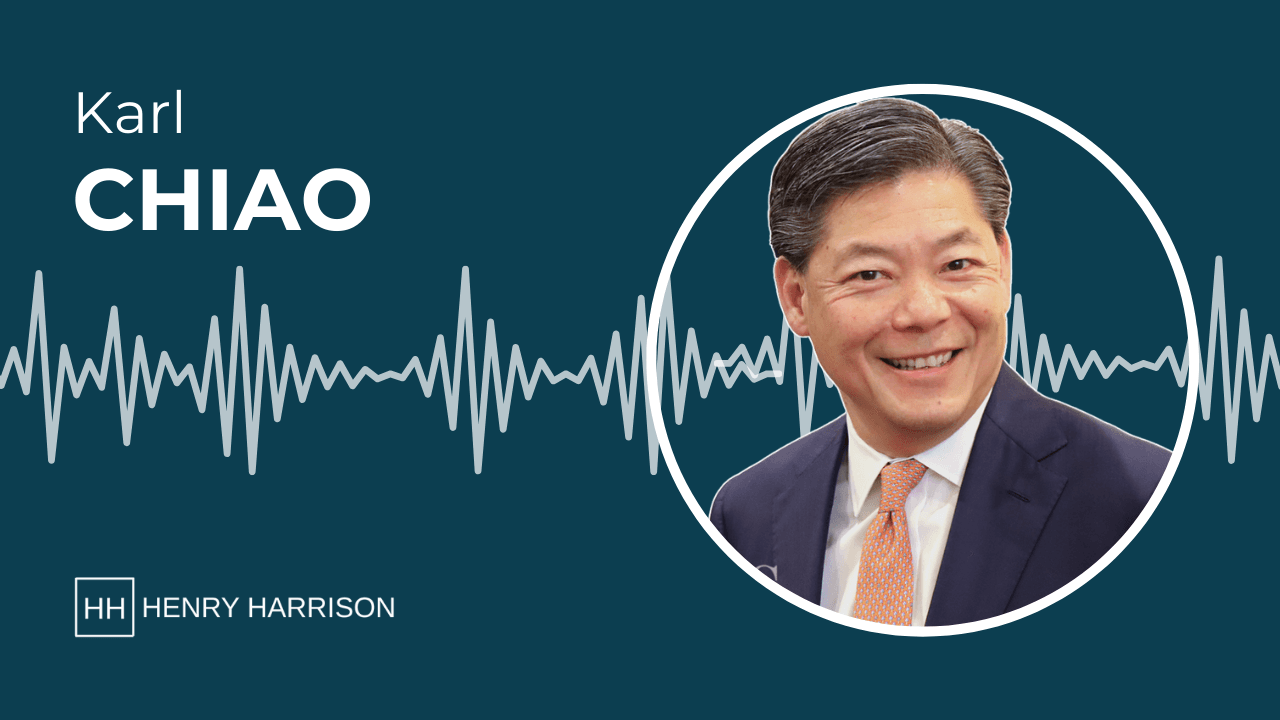
Karl Chiao on Henry Harrison Podcast

Watch / Listen

Listen on SoundCloud

About This Episode

In this episode, Dallas' Henry Harrison sits down with Karl Chiao, current Executive Director at the Dallas Historical Society and real estate developer. A Graduate of Southern Methodist University (SMU ) Dedman School of Law, Karl shares his remarkable journey of arriving in this country as a young boy from Taiwan, Graduating law school, becoming a real estate developer and taking over local and national leader ship positions. He offers valuable insights into his career transitions and success strategies.

Episode Transcript

This transcript has been edited for better readability: Henry Harrison Podcast — Entrepreneurs, Business & Finance Guest: Karl Chiao Henry Harrison Welcome to the show, Karl. Thank you for coming on the Entrepreneurs, Business and Finance podcast. Karl is a very interesting person and a good friend. He has always been deeply involved in the community, and I would say one of the many good things about Karl is that he is truly a give-back kind of guy. That makes this especially interesting because he has ties to the community in many ways, along with a history in real estate development and a range of other ventures. In many ways, his experience is more diverse than most people’s. Why don’t we start with your background? You came to this country as a very young boy. I know you went to Texas A&M and then SMU Law. What was that journey like? Karl Chiao Pretty much. I came to the United States when I was five years old. My parents wanted to see what they could do on their own. Both sides of my family had been part of Chiang Kai-shek’s government that left China in 1949 and went to Taiwan to help establish the Republic of China there. One grandfather had been the Chinese ambassador to Singapore, the other was head of the Chinese Olympic Committee, and my dad played Olympic soccer and basketball. So the family had done very well in Taiwan, but my parents wanted to build something independently in America. We moved to San Antonio, and when I arrived I really couldn’t speak English. I spent the first six months watching Sesame Street and The Electric Company to learn the language. I picked it up quickly. I grew up in San Antonio doing all the things you do in that city, then left for Texas A&M. I started there as an aerospace engineering major, but that lasted about a semester. They always tell you to look left and right because one of those people probably won’t still be there — apparently I was the person to one side. So I changed majors and ended up with a degree in political science. Part of that was because both sides of my family had been involved in politics, and I thought maybe one day I would be too. That eventually led naturally to law school, so I came to Dallas to attend SMU and have now been here for about 34 years. One thing that helped me all along was that I got very good at remembering people. In college, I was the only minority in the Greek system at A&M, so if I walked into a party people remembered me immediately as “Karl, the Asian guy” or “Karl, the Chinese guy.” I realized I needed to be equally good at remembering them. Growing up, I collected baseball cards, and I could remember everyone’s stats, what team they played for, whether they batted left or right, all that kind of thing. I started applying that same mindset to people. I wanted to know who they were, where they were from, and at least three things about them. That turned out to be a very useful skill in life. Henry Harrison You’re also just a genuinely interested person. We actually saw each other only about an hour ago because Karl is kind enough to include me in a weekly lunch he organizes. There were about 12 people there today, and you probably have 80 to 100 or maybe more on an email list who come in and out depending on whether they’re in town or available. Some come every week, some once a month, some once a quarter. You introduce people to each other, and I’ve gotten to reconnect with old friends there and make new ones too. You really are always interested in what other people are doing. Karl Chiao I am. For me, it’s about collecting good people. Just like I collected baseball cards when I was younger, now I like collecting good people because there is nothing better than having good friends you can count on. That lunch has been going on for about 28 years. My former father-in-law used to have a weekly guys’ lunch, and I thought that was such a neat tradition. I decided I wanted something like that too. So I started inviting the sons and grandsons of the men at his lunch, and over time it evolved into this group of maybe 80 or 90 people who get an email every week if I’m in town. It’s a standing lunch every Thursday. What’s amazing is the range of people who show up. It really is a deep bench of people doing interesting and significant things. At the same time, the purpose is not business development. If someone comes and tries to use it in an inappropriate way as a business-hunting exercise, they usually don’t get another email. It’s really meant to be a place for friendship and connection. The point is to help people have good people in their lives. Henry Harrison That reminds me of another group we were both in years ago, the Dallas Roundtable. That was more formal, with an application process and a weekly breakfast. The older I get, the more I appreciate not just meeting new people, but also the longevity of relationships with people I’ve known for 20 years or more. There’s something very reassuring about that. Karl Chiao That was actually my first real introduction to more formal networking. Before that, I had always just had a wide circle of friends, and those friends would bring in their friends, and it became this web of connected people. The Roundtable was different because it was a structured group of 50 people, each from a different business specialty. That was really my first experience with intentional business networking. One thing that came out of that was a realization I had later, when I was helping a friend at his office. He asked me whether I knew what all my lunch friends actually did professionally, and I realized I didn’t. To me, they were just my friends. I knew what they loved — hunting, fishing, sports, philanthropy — but I didn’t necessarily know that one was a CEO or another was president of some major company. Then LinkedIn came along, and I started looking people up. I realized these guys were running companies, leading major organizations, and doing all kinds of impressive things. That actually made me an even better steward of those relationships, because I wanted to make sure I never treated them as contacts instead of as friends. We were friends because we liked each other. That’s the key. Henry Harrison Let’s shift gears to real estate, because we’ve spent time over the years talking about the Destin, Sandestin, and Gulf Coast areas. I know one of your ventures involved development there, and a lot of people in this part of the world know the Florida Gulf Coast from places like Destin and 30A, but you were involved there quite early. Talk a little about what that area was like before so much development arrived, and then about what you’re doing now. Karl Chiao My former father-in-law and I were business partners, and he had built one of the early resorts in Destin called Tops’l Beach and Racquet Club, right across the highway from Sandestin. It was one building, with a tennis club, and Roscoe Tanner — who at the time held the record for the fastest tennis serve in the world — was his head pro. So I already knew that area well. When I got out of law school and joined the family office to work with him, he said, “Why don’t we build a golf course down in the part of the Florida Panhandle where there isn’t one?” This was around 1996. Destin had already developed significantly. Sandestin was growing. WaterColor was coming along. Panama City Beach was still something of a mess because it was so tied to spring break. But once you got farther east toward Apalachicola and the county where the Panhandle starts to turn, there was almost nothing there. They called it the Forgotten Coast. We found a 360-acre property right on the Gulf of Mexico near Carrabelle, Florida, and decided to develop it. We hired Bob Walker, who had been one of the early employees at ClubCorp and then at Arnold Palmer Golf Design. He told us he could deliver Arnold Palmer-level quality without Arnold Palmer-level pricing. So we built a really beautiful golf course called St. James Bay. We had around 420 lots, plus some pad sites for condos. We sold through the lots and did well on that side, but in hindsight I think we were simply too early. By the time the 2008 downturn hit, it was clear that although we had made money on the lots, holding the rest of it no longer made sense strategically. My former father-in-law loved owning a golf course, so we held onto it longer than we probably should have. That was an important lesson for me: if you’ve made your money and you’re early, don’t keep throwing money at something just because you’re emotionally attached to it. That was a good learning experience in development — don’t get too attached. Henry Harrison And now you’re doing something quite different in Dallas, but still within real estate development. Karl Chiao Yes. My former father-in-law originally made a lot of money building office condominiums in Dallas. One of his early successful projects was Woodhill Medical Park near Presbyterian Hospital, where doctors could buy office space right across from the hospital. That idea always stuck with me. So now I’m involved with a group building office condo parks in the northern part of the Dallas-Fort Worth area. One of my partners had been doing this for years in places like Lewisville and Keller, and we approached him around 2021 and said, “You can’t build these fast enough. What if we brought in enough capital and construction capacity to let you expand the model?” He said yes, and since the beginning of 2022 we’ve already worked through several projects, with another now underway in McKinney. These projects are usually around $20 million to build out. We raise about $2.5 million of equity, and then the rest is funded through a revolving construction line. What makes the model attractive is that as the office condos sell, we keep paying down the line and rolling it through the project. By the time the last units are sold, those are largely pure profit. And if the economy changes, we can simply stop after the current building. That’s very different from building something like an 18-story office building, where once you start, you have to finish the entire structure. So the whole model is built around mitigating risk. We’re focusing on places like Prosper, Frisco, Fort Worth near Alliance Airport, and other areas where there are all these new master-planned residential communities, but very little nearby office product. If you’re a lawyer, insurance agent, title company, or another professional living in one of those communities, where do you work? Often you have to drive to Plano or somewhere similar just to find office space. So we go into those communities, often buy the buffer land between retail and residential, and build office condo parks. It’s a great fit, because people can own their space, control their occupancy costs, and work close to home. It’s really a win for everyone. Henry Harrison That’s a great business model, and it sounds exactly like the kind of thing you would put together — practical, clever, and grounded in what communities actually need. Let’s talk about another area where you’ve really given back. We were both in Beta Theta Pi in college, and over the years we would see each other at alumni events. The people running those events were getting older, and eventually someone needed to step up. In true Karl fashion, you did. Now you’re not only involved locally, but also on the national foundation board of Beta Theta Pi and heavily involved in the Dallas alumni chapter. Karl Chiao That’s right. It actually started when I was asked to join the national foundation board. I had always been fond of Beta, because I was in one of the early initiated classes when the chapter was recolonized at A&M. Then once I got involved nationally, people started asking whether I would help more in Dallas, because the alumni chapter here was still active but was really catering to an older group. There are around 1,800 Beta alumni in Dallas, but only 40 or 50 were regularly participating. So I started helping reimagine the local chapter — creating happy hours, younger events, and ways to engage the newer alumni. Our first event under the new approach had about 60 people show up, which was a great start. One thing I care a lot about is that younger guys need mentoring. A fraternity is more than just friendship in college. It can be a lifelong network of people who understand you, can hold you accountable, and can help you grow. Beta’s whole philosophy is about creating men of principle. There is a big emphasis now on leadership development, through things like the Wooden Institute, named after John Wooden, and the Keystone Leadership Conference. The fraternity puts real money into leadership programming for undergraduates. And one of the things I’ve learned through this work is how much younger men are dealing with mental health challenges, especially after COVID. A lot of these guys were isolated, away from home, disconnected from real community, and that had a major impact. The fraternity is paying close attention to that and trying to provide meaningful support. I think that’s one reason the Greek system, when done right, can be so valuable. It gives people a network, accountability, and community. Henry Harrison That’s terrific work, and it says a lot about your priorities. Let’s wrap up with one more major role you have, because you are truly, both formally and informally, a leader in Dallas. You’re also the executive director of the Dallas Historical Society, which is based in Fair Park, one of Dallas’s real treasures. Fair Park has these historic Art Deco buildings, built around the 1936 Texas Centennial, and you’ve really helped bring new life to that institution. Karl Chiao That role actually came out of another part of my background. One of my previous ventures was starting the trusts and estates department at Heritage Auctions back in 2010. Heritage is now the third-largest auction house in the world, and I was dealing with collections, memorabilia, artifacts, and estates all the time. At the same time, a friend of mine who chaired the Dallas Historical Society board asked me to join because the Society had a collection of over three million items, and she thought I could help with collections. So I joined the board. For context, the Dallas Historical Society has been around since 1922, and our mission is to collect, preserve, and exhibit Dallas history so we can educate current and future generations. We’re housed in the Hall of State at Fair Park, which was built for the 1936 Texas Centennial. Fair Park itself has the largest collection of Art Deco buildings in the world, and the Hall of State was built as the centerpiece of that celebration. By 2018, when I was rolling off the board, I realized the Society had gone through something like five directors in six years and around 15 directors in 20 years. We were surviving, but just barely. There wasn’t enough growth, not enough fundraising, and not enough momentum. So I said I would step in for a few years, stabilize things, and get us to the centennial celebration. That was five and a half years ago. Since then, we’ve raised more money in the last five years than in the previous 20. We’ve grown from about five employees to 15, and we’ve brought in some incredible collections. We received Coach Tom Landry’s collection from his family. We acquired the world’s largest diorama of the Battle of the Alamo, which is 24 by 14 feet with over 2,000 figurines and took a man 20 years to create. The building itself has been beautifully renovated and restored to look the way it did in 1936. What I learned is that if you want to run a nonprofit successfully, sometimes you need someone with a for-profit mindset. Not because the mission changes, but because you still have to raise money, manage people, and create momentum. That has been the difference. We treat it seriously, we treat it professionally, and we keep moving forward. We are now one of the few historical organizations in Dallas that is not just surviving, but actually growing. Henry Harrison What a fantastic summary. Even knowing you as well as I do, sitting here listening to all of that is still impressive. Thanks for sharing it, and thank you for coming on the show. Karl Chiao Thank you for having me on. Henry Harrison I’ll see you soon. Karl Chiao Sounds great, Henry. Thank you.

Connect with Karl Chiao

Enjoyed This Episode?

Subscribe to the podcast and never miss an episode. Available on all major platforms.